

Herniated Disc After a Car Accident: What Green Country Patients Need to Know
Disc injuries are one of the most significant and most frequently overlooked consequences of motor vehicle accidents. They produce symptoms that can range from localized neck or back pain to radiating numbness and weakness in the arms or legs, and they frequently do not appear on the imaging tests that most ER and urgent care evaluations rely on, giving patients a false reassurance that their spine is fine when it is not.
At Tulsa Accident Care Center, disc injuries are a routine part of our clinical caseload across all Green Country locations. Here is what you need to understand about how car accidents cause disc injuries, how they present, and what proper evaluation and treatment look like.
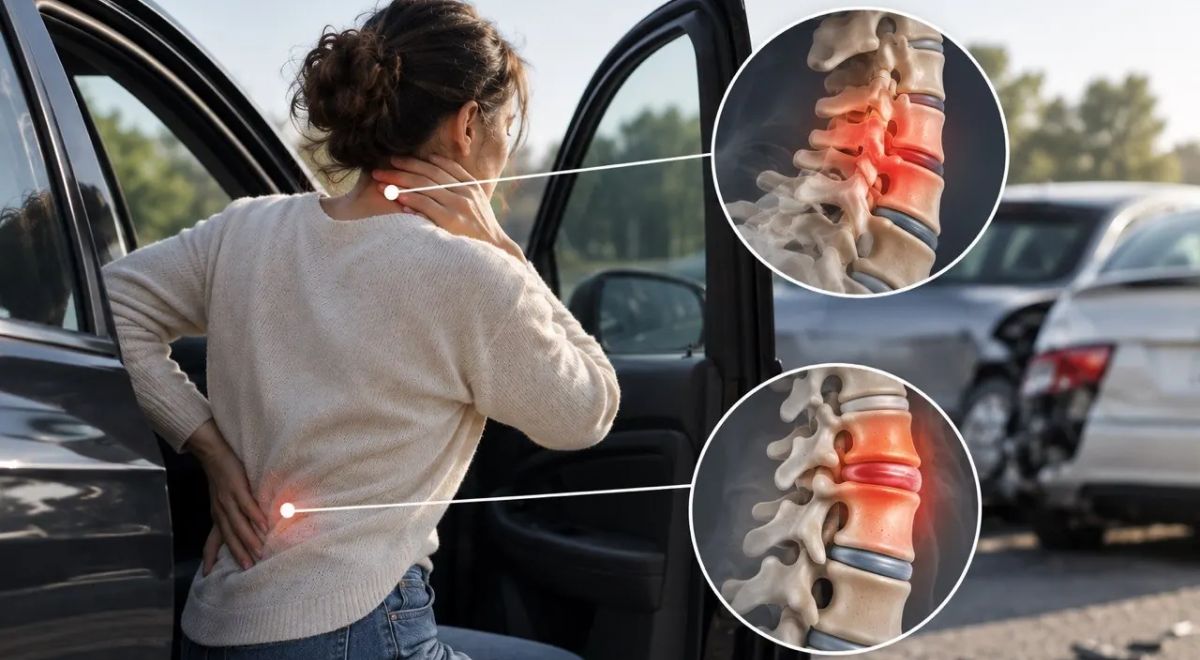
What Is a Herniated Disc?
The spine is made up of vertebrae separated by intervertebral discs, each of which consists of a tough outer ring called the annulus fibrosus surrounding a soft, gel-like center called the nucleus pulposus. These discs function as shock absorbers for the spine, distributing load and allowing the spine to bend and flex.
A herniated disc occurs when a tear in the outer annulus fibrosus allows the softer nucleus pulposus to bulge or protrude outward. When that protrusion presses against a nearby nerve root or the spinal cord itself, it produces the distinctive symptom pattern of a disc herniation: localized pain at the injury site combined with radiating pain, numbness, tingling, or weakness in the limb supplied by the affected nerve.
Disc herniations most commonly occur in the cervical spine, producing symptoms in the shoulders, arms, and hands, and in the lumbar spine, producing symptoms in the hips, legs, and feet. Thoracic disc herniations are less common but can occur in high-force crash scenarios. All three locations are seen at TACC following motor vehicle accidents.
Radiating Pain, Numbness, or Weakness After a Crash?
How Car Accidents Cause Disc Injuries
The forces involved in vehicle collisions are among the most common external causes of disc herniation in adults under 65. The rapid acceleration and deceleration of a crash loads the spine far beyond the forces of normal daily activity, producing a combination of compression, shear, and torsional stresses that can exceed the structural limits of the disc annulus.
In a rear-end collision, the sequence of cervical hyperextension followed by hyperflexion, described in detail in our blog Rear-End Collisions: Why They Are More Serious Than They Look, places the cervical discs under exactly the type of combined loading that produces annular tears. In frontal crashes, the lumbar spine absorbs significant compressive force as the pelvis decelerates against the seatbelt while the torso continues forward. In side-impact collisions, torsional forces load the thoracic and lumbar spine in patterns that rarely occur in normal movement.
Pre-existing disc degeneration, which becomes increasingly common with age, does not prevent crash-related disc herniation; it can accelerate it. A disc that has already developed degenerative changes is more susceptible to herniation under crash loading than a healthy disc. As we explain in our blog Car Accident Recovery for Older Adults: What Changes and Why, insurance carriers sometimes use this pre-existing degeneration to dispute the crash causation of disc injuries in older patients, which is exactly why thorough, crash-specific clinical documentation is essential.
Symptoms of a Herniated Disc After a Car Accident
The symptom profile of a crash-related disc herniation varies based on the level and direction of herniation, but the following presentations are the most common:
Neck or back pain at the injury site.
Often described as a deep, aching pain that is worsened by certain movements, sustained postures, or physical activity.Radiating arm pain (cervical herniation).
Pain, burning, or electrical sensations that travel from the neck into the shoulder, arm, or hand along the distribution of the affected nerve root. Commonly called radiculopathy or radicular pain.Radiating leg pain (lumbar herniation).
Similar radiating symptoms traveling from the lower back into the buttock, thigh, calf, or foot. When the sciatic nerve is involved, this is commonly called sciatica.Numbness and tingling.
Reduced sensation or a pins-and-needles feeling in the arm, hand, leg, or foot supplied by the affected nerve root.Muscle weakness.
Difficulty gripping objects, raising the arm, or bearing weight on a leg, reflecting motor nerve involvement.Headaches originating from the upper cervical spine.
Cervicogenic headaches that may overlap in presentation with post-crash concussion headaches, making accurate differential diagnosis important. Many of these symptoms do not reach their full presentation immediately after the crash. As our blog Top 9 Delayed Injury Symptoms After a Car Accident explains, inflammation around an injured disc builds over the first 24 to 72 hours and can significantly worsen nerve compression symptoms during that window. A patient who has only mild neck stiffness on the day of the crash may wake up two days later with radiating arm pain.Why Standard X-Rays Miss Disc Injuries
One of the most consequential gaps in post-accident care is the frequency with which disc injuries are missed because they are not visible on the imaging modalities most commonly used in ER and urgent care settings. Standard X-rays reveal bone: fractures, dislocations, and significant structural misalignments. They do not image soft tissue structures including the disc itself, the annulus fibrosus, or the nucleus pulposus.
A patient who presents to an ER following a rear-end collision, receives cervical X-rays that show no fracture, and is told their spine looks fine may have a significant disc herniation that the X-ray is structurally incapable of detecting. The correct imaging modality for suspected disc injury is MRI, which provides detailed visualization of the disc, the surrounding soft tissue, and any nerve compression.
As our blog CT, MRI, or X-Ray After a Car Accident: How Doctors Decide What You Need explains in detail, different imaging modalities answer different clinical questions, and the choice of imaging should be guided by the injury pattern rather than defaulting to the least resource-intensive option.
How TACC Evaluates and Treats Disc Injuries
At Tulsa Accident Care Center, disc injury evaluation begins with a comprehensive provider assessment that includes a detailed neurological examination to characterize any nerve involvement, assessment of cervical and lumbar range of motion, and palpation of the spine to identify the level and direction of dysfunction.
When clinical findings suggest a disc herniation, we coordinate diagnostic imaging including MRI referral to confirm the diagnosis and characterize the extent of disc involvement. This imaging then guides the treatment plan, which for most crash-related disc herniations is structured as follows:
Acute phase
Pain management with on-site medication, activity modification guidance, and gentle mobilization to prevent the guarding and stiffness that worsen disc-related pain during the inflammatory phase.Subacute phase
Physical therapy focused on reducing nerve irritation, restoring range of motion, and beginning the core stabilization and cervical strengthening that protect the injured disc from re-loading.Rehabilitation phase
Progressive strengthening and functional training, with osteopathic manipulative therapy to address joint dysfunction in the segments adjacent to the herniation that typically develop secondary dysfunction during recovery.Most crash-related disc herniations managed with appropriate conservative care show meaningful improvement within eight to twelve weeks. Cases that do not respond to conservative management, or that involve significant neurological compromise, are referred for specialist evaluation and possible interventional or surgical options.
Same-day appointments are available at TACC Sand Springs, Tulsa, Broken Arrow, and Owasso. No upfront out-of-pocket costs (NAF). Walk-ins welcome. Call or text 918-888-8080.
Pain stops here.
Neck or Back Pain With Radiating Symptoms After a Crash?
Related Reading
- Rear-End Collisions: Why They Are More Serious Than They Look: The crash mechanism most commonly responsible for cervical disc injuries.
- CT, MRI, or X-Ray After a Car Accident: Why MRI is the correct imaging modality for suspected disc injury.
- Top 9 Delayed Injury Symptoms After a Car Accident: Why disc injury symptoms often worsen in the 48 to 72 hours after a crash.
- How Long Does Recovery Take After a Car Accident?: Recovery timelines for disc injuries compared to other crash injury types.
- Car Accident Recovery for Older Adults: What Changes and Why: Why pre-existing disc degeneration complicates post-accident disc injury claims for older patients.
- What Happens If You Don’t Treat a Car Accident Injury in Oklahoma: Why untreated disc injuries progress from acute to chronic conditions.